The short answer
If Medicare denied your prior authorization for Wegovy or Zepbound for weight management, the Medicare GLP-1 Bridge program changes that, and it is live now. The Bridge is a Centers for Medicare and Medicaid Services (CMS) demonstration that gives eligible Medicare Part D beneficiaries access to Wegovy, Foundayo, and the KwikPen formulation of Zepbound for a $50 per month medication copay, even if a prior Part D prior authorization for the same medication was declined. Provider visits are in addition and are billed through Medicare. The program took effect July 1, 2026 and runs through December 31, 2027.
Eligibility is not automatic. You need to meet one of three BMI-based criteria, complete a prior authorization through the program's central processor, and use the medication alongside structured nutrition and physical activity. We are scheduling Bridge eligibility visits now.
Book a Bridge eligibility visit →
Key takeaways
- The Medicare GLP-1 Bridge is a CMS demonstration program, live July 1, 2026 through December 31, 2027, that gives eligible Medicare Part D beneficiaries access to specific GLP-1 medications for a $50 per month medication copay. Provider visits are in addition and are billed through Medicare.
- Covered medications: all formulations of Wegovy (semaglutide), including both the once-weekly injection and the oral 25 mg tablet; all formulations of Foundayo (orforglipron, an oral tablet); and the KwikPen formulation of Zepbound (tirzepatide, a dual GIP and GLP-1 receptor agonist) only. The Zepbound autoinjector pen is not on the covered list.
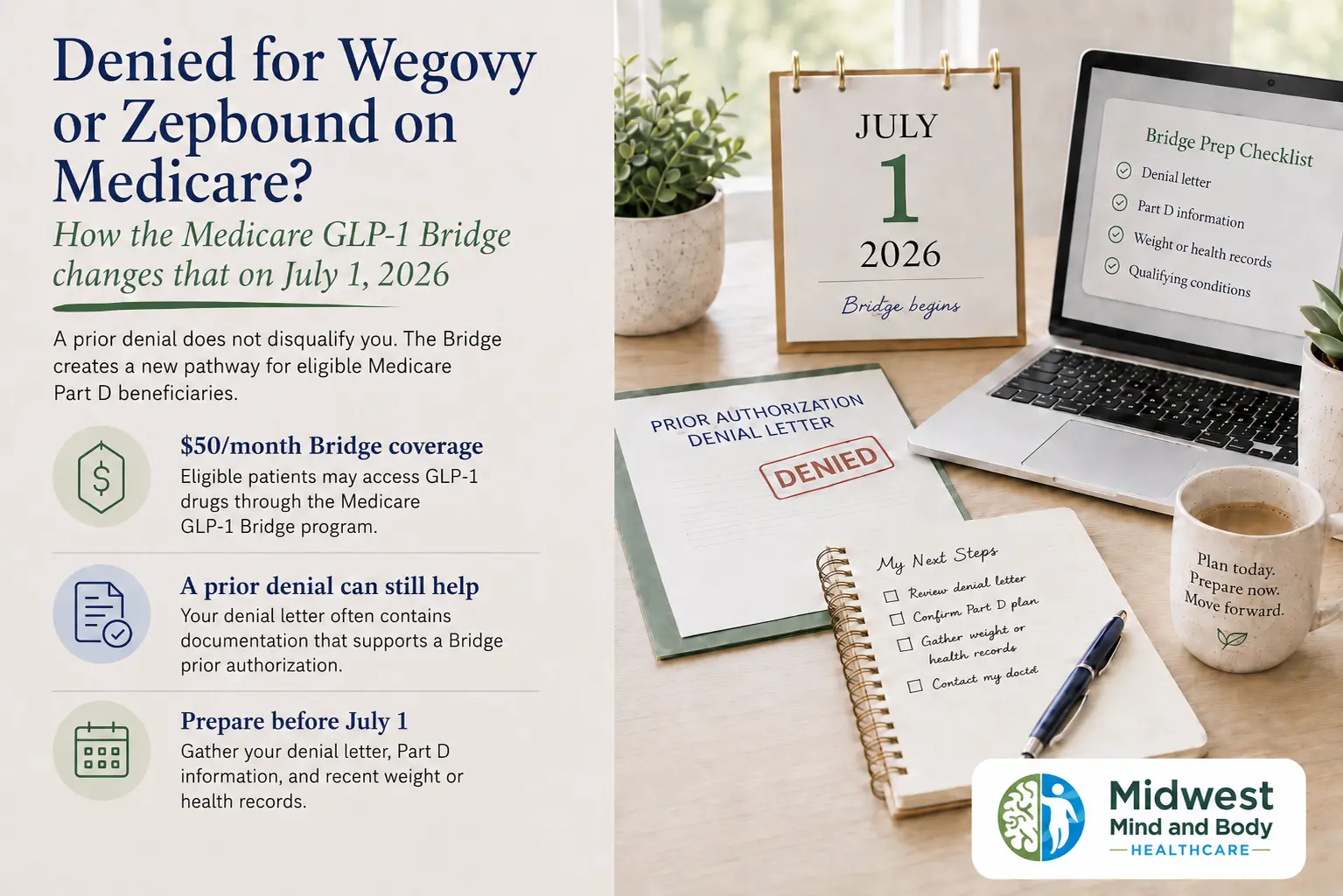
- A prior Part D denial for Wegovy or Zepbound does not disqualify you. The Bridge operates outside the normal Part D coverage flow and uses its own BMI-based eligibility criteria.
- Eligibility requires meeting one of three BMI-based tiers and using the medication alongside structured nutrition and physical activity.
- Providers do not need to be Medicare-enrolled to write Bridge prescriptions. This is a deliberate feature of the program.
- We can review your prior denial paperwork, identify which Bridge tier you most likely qualify under, and submit the Bridge prior authorization now.
Why has Medicare typically denied Wegovy and Zepbound for weight loss?
Before July 1, 2026, traditional Medicare Part D did not cover GLP-1 medications when they were prescribed for chronic weight management. The reason is a longstanding statutory exclusion: drugs prescribed for weight loss are explicitly carved out of Part D. This is why a clean prior authorization for Wegovy or Zepbound, submitted for a weight-management indication, has usually been denied.
There are narrow Medicare coverage exceptions for these molecules:
- Semaglutide (Wegovy) is covered when prescribed for cardiovascular risk reduction in patients with established cardiovascular disease who are also overweight or obese. This indication was added to the Wegovy label in March 2024.
- Ozempic (semaglutide) is covered for type 2 diabetes, for cardiovascular risk reduction in patients with type 2 diabetes and established cardiovascular disease, and for chronic kidney disease outcomes in patients with type 2 diabetes and CKD. Mounjaro (tirzepatide) is covered for type 2 diabetes.
Patients who do not have established cardiovascular disease and do not have type 2 diabetes have typically received a Part D denial when their clinician submitted a prior authorization for Wegovy or Zepbound for chronic weight management. The denial is not a clinical judgment about the patient. It reflects the policy exclusion.
The most common denial reasons we see in practice:
- Indication listed as weight management without a covered comorbidity
- No documented established cardiovascular disease
- Documentation gaps on prior weight-management efforts
- Step therapy requirements not met
- Formulary tier or quantity-limit issues
What did the Bridge change on July 1?
The Bridge is structured deliberately to bypass several of these obstacles.
The program operates outside the normal Part D coverage and payment flow. CMS uses a single central processor for Bridge prior authorization, claims, and pharmacy payment. Part D sponsors do not have to opt in for eligible beneficiaries to access the medications. A previous denial from your Part D plan does not block a Bridge application, because the Bridge does not go through that plan.
Eligibility is based on body mass index (BMI) plus specific qualifying conditions, organized into three tiers covered in detail in our Medicare GLP-1 Bridge eligibility post.
The covered medications are:
- All formulations of Wegovy (semaglutide), including both the once-weekly injection and the once-daily oral 25 mg tablet approved by the FDA in December 2025
- All formulations of Foundayo (orforglipron), which is an oral tablet
- The KwikPen formulation of Zepbound (tirzepatide, technically a dual GIP and GLP-1 receptor agonist) only
The Zepbound autoinjector pen is not on the Bridge covered list. Patients receiving Zepbound through the autoinjector format would need to transition to KwikPen to access Bridge pricing.
One other detail that matters for your access: providers do not need to be enrolled in Medicare to prescribe under the Bridge. This is unusual and is a deliberate feature of the program. It means a non-Medicare-enrolled clinician can write a Bridge prescription that the central processor will adjudicate and pay.
How can a prior denial actually help your Bridge application?
This may sound counterintuitive, but the denial paperwork you received for Wegovy or Zepbound often contains exactly the documentation a Bridge prior authorization will look for.
A typical prior auth submission documented your BMI at the time of the request, any qualifying conditions (hypertension, dyslipidemia, sleep apnea, prediabetes, established cardiovascular disease), your weight management history, and the other treatments you had attempted.
That information transfers. We can review the denial, identify which Bridge tier you most likely qualify under, fill any gaps before July 1, and have the Bridge prior authorization ready to submit through the central processor on day one of the program.
If you do not have your denial paperwork, your Part D plan can provide a copy of the denial letter or the prior authorization decision on request.
What we see in clinic when Medicare patients call
The conversations have shifted noticeably over the last several weeks. A few patterns:
The patient who got a Part D denial last year and assumed weight-loss medications were permanently off the table. The Bridge is a real change for this patient. We slow down, review the denial, and identify which tier most likely applies. In many cases the documentation is already most of what is needed.
The patient who has been paying $1,000 or more per month in cash for Wegovy and is exhausted. The Bridge does not retroactively cover anything. It starts July 1. But for someone already meeting the clinical criteria, we can help them transition off cash payment and onto Bridge coverage from day one of the program.
The patient currently on Zepbound through commercial savings programs who is concerned about the autoinjector exclusion. We talk through the KwikPen formulation, what the transition looks like, and whether continued cash-pay versus Bridge KwikPen is the right call for them. Some patients prefer to stay with the autoinjector format despite the higher cost, and that is a legitimate choice.
The patient on compounded GLP-1 from a telehealth subscription service who wants to know what the Bridge does for them. The Bridge does not cover compounded medications. It covers FDA-approved branded products only. We discuss transition options, what to expect from a switch in formulation, and whether the brand-name path is the right one for that patient now.
The patient with a Medicare Advantage plan whose Part D formulary already covers Wegovy through a non-Bridge pathway. For some of these patients, staying on their existing MA plan coverage may be simpler than switching to the Bridge. We evaluate which path makes more sense based on the specific plan and the patient's situation.
What we ask before starting a Bridge prior authorization:
- Confirmation of Medicare Part D enrollment
- Recent BMI and weight history
- A list of qualifying conditions (cardiovascular, kidney, prediabetes, established CVD, etc.)
- Documentation of structured nutrition and physical activity. CMS guidance and the relevant FDA labels describe this as a reduced-calorie diet plus approximately 150 minutes per week of physical activity, which is a useful documentation benchmark.
- The denial letter or prior authorization paperwork, if available
- Personal and family history of medullary thyroid carcinoma or MEN 2, which is contraindicated per the FDA boxed warning for all GLP-1 medications, Bridge or otherwise
What we do not assume:
- That every Medicare patient qualifies for the Bridge
- That the Bridge is the right path for every eligible patient
- That the patient who has paid cash for a year is necessarily eager to switch formulations
Kim Wohlwend, MSN, APRN
The three BMI eligibility tiers, briefly
The Bridge uses three BMI-based pathways. Meeting any one of them qualifies a patient for $50 per month coverage. They are:
- BMI 35 or higher (no additional condition required)
- BMI 30 to 34.9 with heart failure, uncontrolled hypertension, or chronic kidney disease
- BMI 27 to 29.9 with prediabetes, prior heart attack, prior stroke, or symptomatic peripheral artery disease
Our Medicare GLP-1 Bridge eligibility tiers post covers each tier in detail, including the documentation the central processor will look for. You can also use our free, private eligibility calculator to estimate your tier in about 60 seconds. The calculator runs entirely on your device and does not transmit your information anywhere.
What should you do now that the Bridge is live?
If you have been denied for Wegovy or Zepbound in the past and want to use the Bridge, here is what we suggest.
First, use the eligibility calculator. It is free, private, and takes about a minute. If your tier looks marginal, that is useful information to bring to your visit.
Second, locate your prior denial paperwork. Your Part D plan can provide a copy on request if you do not have it.
Third, gather your current BMI, recent blood pressure readings, recent A1c if you have one, and a list of any cardiovascular or kidney conditions and prior events.
Fourth, schedule a visit. We can review eligibility, fill any documentation gaps, talk through the medication options, and submit your Bridge prior authorization through the central processor. Provider visits are billed through Medicare; your share depends on your specific Medicare coverage, and we review what to expect when you schedule.
What does the Bridge NOT change?
The Bridge is a real change. It is not a universal solution. A few clarifications worth keeping in mind:
- The Bridge does not retroactively cover medication you have already paid for.
- The Bridge does not extend to compounded versions of semaglutide, tirzepatide, or orforglipron. It covers FDA-approved branded products only.
- The Bridge does not change the contraindications for these medications. Personal or family history of medullary thyroid carcinoma or MEN 2 remains contraindicated per the FDA boxed warning for all GLP-1 medications.
- Zepbound has a separate FDA-approved indication for moderate to severe obstructive sleep apnea in adults with obesity. For Medicare patients with documented OSA, this may provide a Part D coverage pathway under the OSA indication, independent of the Bridge.
- The Bridge does not cover the Zepbound autoinjector pen. KwikPen formulation only.
- The Bridge does not cover Ozempic or Mounjaro for diabetes. Those continue to be covered under their existing Part D indications when prescribed for that purpose.
- The Bridge is a demonstration program. It is scheduled to run from July 1, 2026 through December 31, 2027. What happens after December 31, 2027 is not yet determined.
The bottom line
If you have been denied for Wegovy or Zepbound on Medicare in the past, the Bridge is a substantial change, and it is live now. Your previous denial does not block a Bridge application. The documentation from that denial often helps it.
The patients best positioned to benefit from the Bridge are the patients whose evaluation and prior authorization are complete. That is what the eligibility visit is for.
We are prescribing under the Bridge now, and we can complete the evaluation and submit your prior authorization documentation.
Frequently asked questions
I was denied for Wegovy by Medicare last year. Can I still apply for the Bridge?
Yes. A prior Part D denial does not disqualify you from the Medicare GLP-1 Bridge. The Bridge operates outside the normal Part D coverage flow and uses its own BMI-based eligibility criteria. The denial paperwork is often useful documentation for the Bridge prior authorization.
Do I need to switch Medicare plans to access the Bridge?
No. Eligibility for the Bridge is based on Medicare Part D enrollment and the three BMI-based tiers. You do not need to switch Part D plans. CMS uses a single central processor that handles Bridge prior authorization, claims, and pharmacy payment, separate from each Part D sponsor.
Are you prescribing under the Bridge now?
Yes. The Medicare GLP-1 Bridge took effect July 1, 2026, and we are seeing Medicare patients and submitting Bridge prior authorizations now, in person in Papillion or by telehealth in 16 states. Per CMS rules, providers do not need to be enrolled in Medicare to prescribe under the Bridge. Our own Medicare enrollment application is pending; provider visits will be billed through Medicare once it is approved.
Does the Bridge cover Ozempic or Mounjaro?
No. The Bridge covers all formulations of Wegovy (semaglutide), all formulations of Foundayo (orforglipron), and the KwikPen formulation of Zepbound (tirzepatide) only. Ozempic and Mounjaro continue to be covered under their respective FDA-approved Part D indications. Mounjaro is approved for type 2 diabetes. Ozempic is approved for type 2 diabetes and, in patients with type 2 diabetes, for cardiovascular risk reduction with established CVD and for kidney outcomes in CKD.
I am currently on compounded semaglutide. Does the Bridge change anything for me?
The Bridge does not cover compounded medications. It covers FDA-approved branded products only. If you currently use compounded semaglutide and want to transition to a branded medication under the Bridge, we can discuss the options during a visit. The FDA's enforcement actions follow the end of the semaglutide shortage declaration in 2025, which removed the legal basis for most 503A and 503B compounding of semaglutide; that is a separate consideration.
I am on a Zepbound autoinjector pen. Will the Bridge cover that?
No. The Bridge covers only the KwikPen formulation of Zepbound. To access Bridge pricing, a transition from the autoinjector to KwikPen would be required. We talk through the practical considerations of that transition during the visit.
What if I do not have my Medicare denial paperwork?
Your Part D plan can provide a copy of the denial letter or the prior authorization decision on request. You can also bring whatever documentation you do have, and we will work from what is available to identify any gaps before the Bridge prior authorization is submitted.
Evidence & References
- Medicare GLP-1 Bridge. Centers for Medicare and Medicaid Services.
- Coming Soon: CMS to Provide $50 Monthly Access to GLP-1 Medications for Medicare Beneficiaries. CMS press release.
- Regulatory NewsBREAK: CMS Releases Frequently Asked Questions on the Medicare GLP-1 Bridge. AMCP, 2026.
- What to Know About the BALANCE Model for GLP-1s in Medicare and Medicaid and the Medicare GLP-1 Bridge. KFF.
- CMS Provides Details for "Medicare GLP-1 Bridge" Coverage for Eligible Part D Beneficiaries. ReedSmith Health Industry Washington Watch.
Were you denied for Wegovy or Zepbound on Medicare? The Bridge is live.
If a prior Part D denial has kept you off Wegovy or Zepbound for weight management, we can review your eligibility, fill any documentation gaps, and submit your Bridge prior authorization now. Try the free eligibility calculator first if you would like a 60-second tier estimate. Provider visits are billed through Medicare; your share depends on your coverage.
Not ready to book a visit? Sign up for Bridge email updates below and we will keep you posted on program changes and scheduling.
Schedule a Bridge eligibility visit Get Bridge updatesThis content is for educational purposes only and does not replace medical advice. Bridge eligibility, prior authorization decisions, and the appropriate medication for any individual patient are individualized determinations made during a clinical evaluation. Program details and covered medications are based on Centers for Medicare and Medicaid Services guidance as of June 15, 2026 and may be updated by CMS. This page will be updated when material program details change.