You qualify for the Medicare GLP-1 Bridge if you are enrolled in Medicare Part D and meet one of three BMI-based tiers: BMI 35 or higher alone; BMI 30 or higher with heart failure with preserved ejection fraction, uncontrolled hypertension on two or more medications, or chronic kidney disease stage 3a or higher; or BMI 27 or higher with prediabetes, prior heart attack, prior stroke, or symptomatic peripheral artery disease. All tiers also require pairing the medication with structured nutrition and physical activity, plus prior authorization through your Part D plan.
Find out if you qualify in 60 seconds.
Use the free Medicare GLP-1 Bridge eligibility calculator. Enter your height, weight, Part D status, and any qualifying conditions. The result tells you which tier you appear to meet. Everything runs in your browser; nothing is transmitted to our practice or any server.
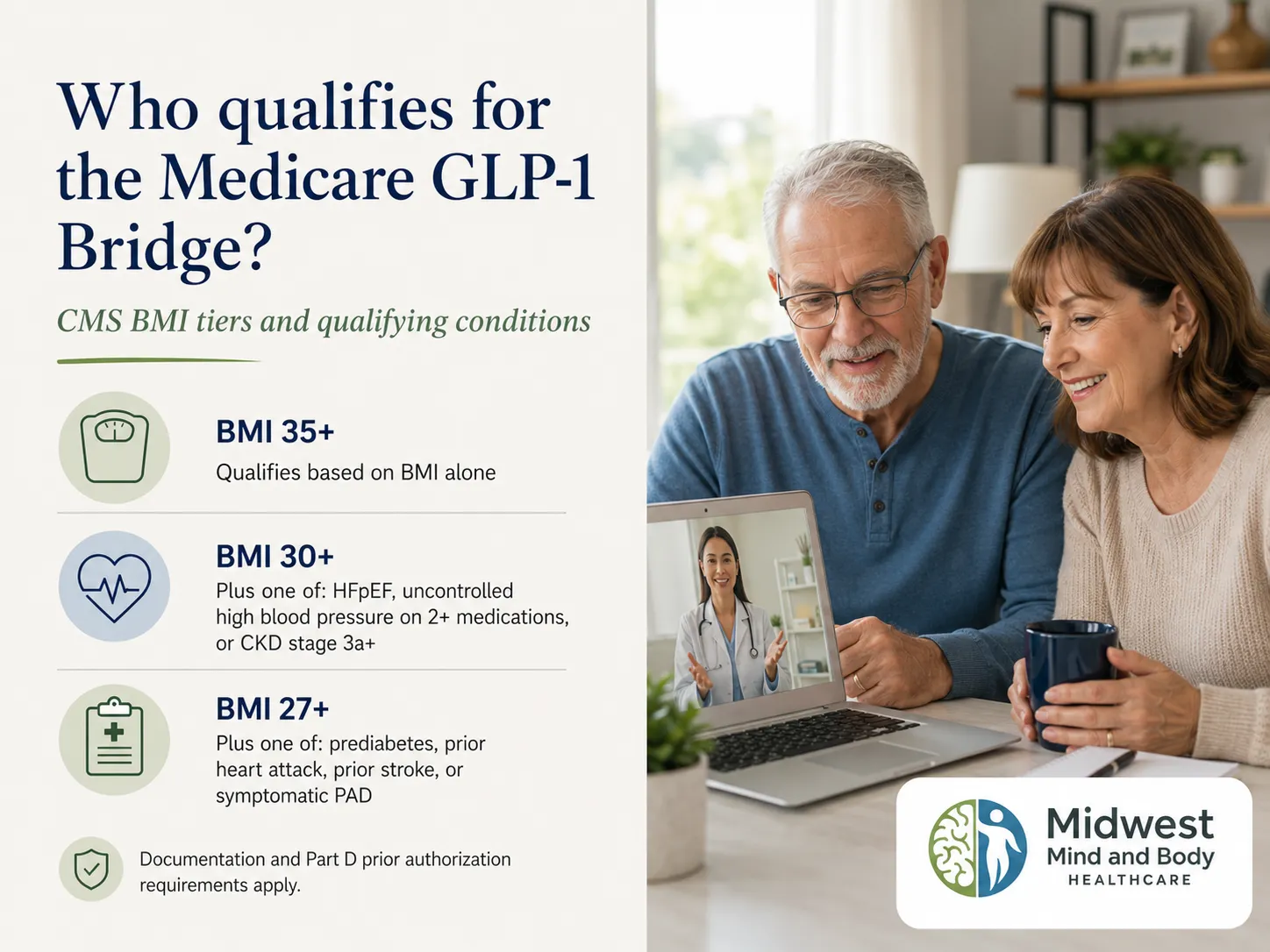
The Medicare GLP-1 Bridge Program is more restrictive than the FDA label for Wegovy or Zepbound. Where the FDA approves these medications for adults with a BMI of 30, or a BMI of 27 with a weight-related comorbidity, the Bridge sets specific BMI thresholds paired with a defined list of qualifying conditions. The result is a three-tier eligibility framework, and which tier you fall under matters less than the fact that meeting any one of them gives you the same $50 per month medication coverage.
Eligibility is checked at your clinical evaluation visit. Your BMI is measured. Your medical history is reviewed. The qualifying conditions are confirmed against documentation in your medical record. Your clinician then submits a prior authorization request to your Medicare Part D plan referencing the appropriate tier. Approval typically takes a few business days.
Key takeaways
- The Medicare GLP-1 Bridge has three BMI-based eligibility tiers. You only need to qualify under one to receive $50 per month medication coverage.
- Tier 1 (BMI 35 or higher) requires no additional conditions.
- Tier 2 (BMI 30 or higher) requires heart failure with preserved ejection fraction, uncontrolled hypertension on two or more medications, or chronic kidney disease stage 3a or higher.
- Tier 3 (BMI 27 or higher) requires prediabetes, previous heart attack, previous stroke, or symptomatic peripheral artery disease.
- All tiers also require Medicare Part D enrollment, structured nutrition and physical activity, and prior authorization through your plan.
- Your clinician submits documentation for whichever tier best fits; the Bridge price and benefit are identical across all three.
The three eligibility tiers, at a glance
| Tier | BMI requirement | Additional condition required |
|---|---|---|
| Tier 1 | 35 or higher | None |
| Tier 2 | 30 or higher | One of: HFpEF, uncontrolled hypertension on two or more medications, or CKD stage 3a or higher |
| Tier 3 | 27 or higher | One of: prediabetes, previous heart attack, previous stroke, or symptomatic peripheral artery disease |
The tiers are pathways, not exclusive BMI ranges. You qualify if you meet any one of them. A patient with a high BMI may meet more than one pathway (for example, BMI 38 with prior stroke meets Tier 1 by BMI alone and Tier 3 by stroke), and that overlap is fine. Lower-BMI tiers require a more specific condition because CMS structured the program so the patients most likely to benefit clinically (those with the highest combined disease burden) qualify.
Tier 1: BMI 35 or higher
BMI 35 or higher, no other conditions required.
This is the broadest tier and the simplest to qualify under. If your BMI is 35 or above at your clinical evaluation, you qualify regardless of any other medical history. Your clinician submits prior authorization documenting your current BMI, and the rest is paperwork.
What counts as BMI 35? BMI is calculated as weight in kilograms divided by height in meters squared. For practical reference: a person who is 5'4" (1.63 m) reaches BMI 35 at approximately 204 pounds; 5'6" reaches it at approximately 217 pounds; 5'8" at approximately 230 pounds; 5'10" at approximately 243 pounds; 6'0" at approximately 258 pounds. Your exact threshold weight depends on your exact height, and the eligibility calculation uses your measured weight and height, not a self-reported estimate. You can also use our free calculator to confirm.
Tier 1 is where most patients with class II or class III obesity qualify. It does not require any specific comorbidity, but Medicare still expects prior authorization documentation and pairing of the medication with structured nutrition and physical activity. We discuss what "structured" means in practice during the visit.
Tier 2: BMI 30 or higher with a qualifying condition
BMI 30 or higher, plus one specific condition.
Three conditions qualify a patient under Tier 2. Each must be documented in your medical record before prior authorization is submitted. A patient with BMI 35 or higher would also meet Tier 1 by BMI alone, which is simpler to document.
Tier 2 conditions in detail:
Heart failure with preserved ejection fraction (HFpEF)
HFpEF is heart failure with a left ventricular ejection fraction of 50 percent or higher on echocardiogram. It is a common form of heart failure in patients with obesity, hypertension, and metabolic syndrome, and it has become a recognized clinical target for incretin-based therapy following the STEP-HFpEF trial (semaglutide in HFpEF with obesity) and the SUMMIT trial (tirzepatide in obesity-related HFpEF). To document HFpEF for Bridge eligibility, your medical record should show a confirmed clinical diagnosis with supporting echocardiogram and, in most cases, an ICD-10 code in the I50.30, I50.31, or I50.32 family.
Uncontrolled hypertension despite treatment with two or more antihypertensive medications
"Uncontrolled" generally means a systolic blood pressure consistently above 140 or a diastolic above 90 despite ongoing treatment with at least two antihypertensive medications from different drug classes (such as an ACE inhibitor or ARB, a calcium channel blocker, a thiazide diuretic, or a beta-blocker). Documentation should show recent in-clinic blood pressure measurements, an active medication list with at least two antihypertensives, and adherence with the medication regimen.
Chronic kidney disease stage 3a or above
CKD stage 3a corresponds to an estimated glomerular filtration rate (eGFR) of 45 to 59 mL/min/1.73 m² for at least three months. Stage 3b is eGFR 30 to 44, stage 4 is 15 to 29, and stage 5 is below 15 or on dialysis. Any of these qualifies. The stage 3a threshold aligns with the renal-protective findings of the FLOW trial, which demonstrated meaningful kidney protection from semaglutide in adults with type 2 diabetes and CKD. Your medical record should show two qualifying eGFR values at least 90 days apart, plus an ICD-10 code in the N18 family.
Tier 3: BMI 27 or higher with a qualifying condition
BMI 27 or higher, plus one specific condition.
Four conditions qualify a patient under Tier 3. These reflect either elevated cardiometabolic risk (prediabetes) or established cardiovascular disease (prior heart attack, prior stroke, symptomatic PAD). A patient with BMI 30 or higher who also has a Tier 2 condition would meet Tier 2 separately; the Bridge benefit is the same either way.
Tier 3 conditions in detail:
Prediabetes
The American Diabetes Association defines prediabetes as fasting plasma glucose of 100 to 125 mg/dL, a 2-hour plasma glucose of 140 to 199 mg/dL on an oral glucose tolerance test, or an A1c of 5.7 to 6.4 percent. Any one of these on your most recent lab work supports the diagnosis. Documentation should include the lab result, an ICD-10 code (typically R73.03 for prediabetes), and ideally a note confirming the diagnosis in your clinician's assessment.
Previous heart attack (myocardial infarction)
A documented history of any prior myocardial infarction qualifies, whether STEMI or NSTEMI, regardless of how long ago. Your medical record should include the date of the event, the location of care, any cardiac catheterization or stenting records, and an ICD-10 code (often I21 for acute MI or I25.2 for old MI).
Previous stroke
A documented history of ischemic or hemorrhagic stroke qualifies. Transient ischemic attacks (TIA) are evaluated case-by-case; some plans accept TIA documentation, others require a fully completed stroke. Documentation should include the date of event, imaging results (CT or MRI), and an ICD-10 code (typically I63 for ischemic stroke or I69 for stroke sequelae).
Symptomatic peripheral artery disease
"Symptomatic" PAD means PAD with clinical manifestations such as claudication, rest pain, non-healing wounds, or prior revascularization. Asymptomatic PAD detected only on screening is not sufficient under Bridge criteria. Documentation should include symptom history, ankle-brachial index (ABI) results if available, imaging if available, and an ICD-10 code (often I70.21 or I73.9).
Requirements that apply to all three tiers
Meeting a tier is necessary but not sufficient. All Bridge participants must also satisfy these requirements:
- Medicare Part D enrollment. The Bridge benefit is paid through your Part D plan, whether that is a standalone Prescription Drug Plan (PDP) or a Medicare Advantage plan with prescription drug coverage (MA-PD). Patients with Original Medicare and no Part D enrollment cannot use the Bridge until they enroll, which typically happens during an open enrollment period.
- Age 18 or older. The Bridge is for adult Medicare beneficiaries.
- Structured nutrition and physical activity. CMS expects the medication to be part of a comprehensive weight-management approach, not a standalone intervention. This does not require formal enrollment in a specific program; documented counseling, dietary recommendations, and an activity plan from your clinician generally satisfy this.
- Prior authorization through your Part D plan. Your clinician submits the prior authorization request with documentation of BMI, qualifying condition, and the nutrition/activity component. Most plans approve within a few business days; some request additional documentation.
- No contraindication. Bridge medications are incretin-based therapies (Wegovy and Foundayo are GLP-1 receptor agonists; Zepbound is a dual GIP and GLP-1 receptor agonist). Each carries specific FDA-labeled contraindications, plus a set of clinical precautions that prompt careful screening. We review these at the evaluation visit.
- Prescribing clinician not on the CMS Preclusion List. Providers do not need to be enrolled in Medicare to write a Bridge prescription, but they must not appear on the CMS Preclusion List, which excludes a small number of providers from billing Medicare programs.
What documentation does your Part D plan need?
Most Part D plans require the following items in the prior authorization request:
- A current, measured BMI with date and source
- An ICD-10 code for obesity or overweight (commonly E66.01, E66.09, E66.811, or E66.812 for obesity; E66.3 for overweight)
- An ICD-10 code for the qualifying tier condition, where applicable
- The prescribing clinician's National Provider Identifier (NPI) and a statement that they are not on the CMS Preclusion List
- Documentation that the medication will be used alongside structured nutrition and physical activity
- Date of last clinical visit with the prescribing provider
- The specific medication being requested (Wegovy, Zepbound, or Foundayo) with dose and quantity
Some Part D plans add requirements such as documented prior lifestyle intervention attempts, weight history over the past 24 months, or signed patient acknowledgment of the long-term nature of treatment. These requirements vary by plan and are worth confirming with your plan in advance if your prior authorization stalls.
Common edge cases we see in clinic
Most Bridge questions have a clear yes-or-no answer. A few patterns recur often enough to address up front: borderline BMI just under a tier threshold, type 2 diabetes paired with a non-diabetes condition, prediabetes paired with a BMI above the Tier 3 range, and patients who meet more than one tier. Each is discussed below.
Your BMI is 26.8 (just under the Tier 3 threshold)
You do not currently meet a Bridge tier. If your BMI has been higher in the past 12 months and is documented in your medical record, that historical BMI may be relevant; plans handle this inconsistently and it depends on policy. Otherwise, you do not appear to qualify for the Bridge, and a clinical visit can confirm and discuss other weight-management options.
You have type 2 diabetes and your BMI is 32
Type 2 diabetes itself is not on the Bridge eligibility list. The Bridge covers GLP-1 for chronic weight management. However, if you also have CKD stage 3a, HFpEF, or uncontrolled hypertension on two medications, you qualify under Tier 2 by meeting the cardiovascular or kidney condition (not by diabetes). Separately, you may already have coverage for Ozempic, Mounjaro, or Rybelsus through Part D for diabetes management; that is independent of the Bridge.
You have prediabetes (A1c 6.0) and your BMI is 31
You qualify under Tier 3. Tier 3 requires a BMI of 27 or higher with prediabetes (or another Tier 3 condition), and a BMI of 31 meets that floor. You do not need to meet Tier 2 separately; meeting any one tier is sufficient. This is a common point of confusion because the tier numbering suggests exclusive ranges, but each tier is actually a minimum BMI plus a defined condition set, and the tiers can overlap.
You meet multiple tiers
This is common and changes nothing. The Bridge benefit is identical across tiers. Your clinician submits prior authorization under the most clearly documented qualifying pathway, which is usually whichever has the strongest medical record support.
Conditions that do not qualify under the Bridge (commonly asked)
The following do not qualify under any Bridge tier, even when paired with the right BMI:
- Type 2 diabetes alone. Covered under separate Part D rules for diabetes-indicated GLP-1 medications.
- Obstructive sleep apnea. Not on the Bridge eligibility list, but Zepbound carries an FDA indication for moderate-to-severe OSA in adults with obesity that may be covered by your Part D plan independently of the Bridge.
- Polycystic ovary syndrome (PCOS). Not on the Bridge list.
- Fatty liver disease (NAFLD or MASH). Not on the Bridge list, though it may be covered for specific FDA-approved indications outside the Bridge.
- Asymptomatic peripheral artery disease. Symptomatic PAD qualifies; PAD detected only on screening does not.
- High cholesterol (dyslipidemia) alone. Not on the Bridge list.
- Family history of cardiovascular disease. Personal history of MI or stroke qualifies; family history alone does not.
This list is based on the published CMS Bridge guidance and may be updated as CMS issues clarifications. We confirm the current list at every eligibility visit.
When the Bridge is not the right path
Some patients meet a Bridge tier on paper but should not start treatment. Wegovy and Foundayo are GLP-1 receptor agonists. Zepbound is a dual GIP and GLP-1 receptor agonist. The three medications share most safety considerations, with two categories to distinguish:
FDA-labeled contraindications
These are absolute. If any apply, the medication should not be prescribed:
- Personal or family history of medullary thyroid carcinoma (MTC)
- Multiple Endocrine Neoplasia syndrome type 2 (MEN 2)
- Known serious hypersensitivity to the active medication or to a related incretin-receptor agonist
Clinical precautions that prompt careful screening
These are not absolute contraindications on the FDA label, but they meaningfully change the risk-benefit conversation. Some patients in these categories may still be candidates with close monitoring; others should not start treatment. The decision is individualized:
- Pregnancy, breastfeeding, or planning pregnancy within the next two months. FDA labeling advises against use during pregnancy and breastfeeding, with discontinuation recommended at least two months before a planned pregnancy.
- Severe or symptomatic gastroparesis. Because GLP-1 and GIP/GLP-1 agonists slow gastric emptying, established gastroparesis can worsen on treatment.
- Active eating disorder (anorexia nervosa, bulimia nervosa, or binge eating disorder under active treatment). Not an FDA-labeled contraindication, but appetite suppression in this population requires specialized risk assessment.
- History of pancreatitis or active gallbladder disease. Both medications can rarely cause pancreatitis or worsen gallbladder symptoms.
- Diabetic retinopathy in patients with type 2 diabetes. Rapid glycemic improvement can transiently worsen retinopathy.
If an absolute contraindication applies, the Bridge is not the right path and we discuss alternatives at the visit. These may include non-GLP-1 weight-management medications (such as phentermine-topiramate or bupropion-naltrexone), referral to bariatric surgery evaluation, or structured lifestyle programs without medication. If a clinical precaution applies, the conversation is individual and may still end with treatment under close monitoring.
How to check your eligibility quickly
The fastest way to get a private estimate is the free eligibility calculator on our site. It asks for height, weight, Part D status, qualifying conditions, and contraindications. Everything runs in your browser; nothing is transmitted to our practice or any server. The result tells you which tier you appear to meet, or whether the Bridge does not appear to fit.
A calculator result is a starting point, not a clinical decision. Final Bridge eligibility is determined by your Medicare Part D plan's prior authorization review based on clinician-documented diagnoses. If the calculator suggests you may qualify, the next step is an eligibility visit where we confirm BMI, review your medical record, and submit prior authorization. If the calculator suggests you may not qualify, a clinical conversation can still be useful; some patients have documented conditions they did not know about, and some have BMI in a range we can revisit at a future visit.
Frequently asked questions
What BMI do I need for the Medicare GLP-1 Bridge?
A BMI of 27 or higher is the lowest threshold, and it only qualifies under Tier 3 alongside specific cardiovascular or metabolic conditions. A BMI of 30 qualifies under Tier 2 with one of three specific conditions. A BMI of 35 or higher qualifies under Tier 1 with no additional conditions required. Your BMI is measured at the eligibility visit, and historical BMI documented in your medical record may also be considered.
What conditions count for Tier 2 of the Medicare GLP-1 Bridge?
Three specific conditions qualify for Tier 2 (BMI 30 or higher): (1) heart failure with preserved ejection fraction (HFpEF), (2) uncontrolled hypertension despite treatment with two or more antihypertensive medications (systolic over 140 or diastolic over 90), and (3) chronic kidney disease stage 3a or higher (estimated GFR below 60). Each must be documented in your medical record by a clinician. A patient with BMI 35 or higher would also meet Tier 1 by BMI alone.
What conditions count for Tier 3 of the Medicare GLP-1 Bridge?
Four specific conditions qualify for Tier 3 (BMI 27 or higher): (1) prediabetes per American Diabetes Association criteria (typically A1c 5.7 to 6.4 percent, fasting glucose 100 to 125, or 2-hour oral glucose tolerance test 140 to 199), (2) previous heart attack (myocardial infarction), (3) previous stroke, and (4) symptomatic peripheral artery disease. The condition must be documented in your medical record. Tiers can overlap: a patient with BMI 32 and prediabetes meets Tier 3 (BMI 27 or higher with a Tier 3 condition) and qualifies for the Bridge.
Does type 2 diabetes qualify for the Medicare GLP-1 Bridge?
No, not by itself. The Bridge Program covers GLP-1 medications for chronic weight management, not for type 2 diabetes. Patients with type 2 diabetes who also meet a Tier 2 or Tier 3 condition (such as HFpEF, CKD, prior heart attack, or stroke) and the corresponding BMI threshold may qualify under the Bridge for chronic weight management. Patients with type 2 diabetes alone may have GLP-1 coverage under Medicare Part D for diabetes management with Ozempic, Mounjaro, or Rybelsus separately from the Bridge.
What if my BMI is just under 27?
You do not meet the minimum BMI for the Medicare GLP-1 Bridge. Some patients hover near a threshold and may qualify after a small weight change in either direction. A clinical visit can confirm current BMI, review historical documented BMI, and identify whether other medical paths to weight management are appropriate. Non-GLP-1 medications and structured lifestyle programs may also be options.
Does sleep apnea qualify under the Medicare GLP-1 Bridge?
Obstructive sleep apnea (OSA) is not on the CMS Bridge eligibility list. However, OSA is an FDA-approved indication for Zepbound (tirzepatide) outside the Bridge, based on the SURMOUNT-OSA trial. Medicare Part D coverage of Zepbound for OSA in adults with obesity follows separate plan-by-plan rules and is not part of the Bridge demonstration.
What documentation does my Part D plan need to approve the Bridge?
Most Part D plans require a current BMI measurement documented at a recent clinical visit, ICD-10 codes for any qualifying conditions, a record of structured nutrition and physical activity, and the prescribing clinician's prior authorization request. Some plans also require documentation of prior lifestyle intervention attempts. Your clinician submits this through the plan's prior authorization process.
Can I qualify if I meet more than one tier?
Yes, and it does not change your $50 per month cost. Bridge medication coverage is the same regardless of which tier you qualify under. If you have a BMI of 38 and HFpEF, you qualify under both Tier 1 (BMI alone) and Tier 2 (BMI 30+ with HFpEF). Your clinician submits prior authorization under the most clearly documented qualifying pathway.
Three paths from here.
Use the free calculator to estimate your tier in 60 seconds (private, runs in your browser). The Bridge is live now, so you can book an eligibility visit, or see the full service page for pricing, prior authorization process, and how to enroll.
References and citations
- Centers for Medicare & Medicaid Services. Medicare GLP-1 Bridge. cms.gov/medicare/coverage/prescription-drug-coverage/medicare-glp-1-bridge
- American Diabetes Association. Standards of Care in Diabetes (current edition). Definitions of prediabetes and type 2 diabetes.
- Kosiborod MN, et al. Semaglutide in Patients with Heart Failure with Preserved Ejection Fraction and Obesity (STEP-HFpEF). New England Journal of Medicine, 2023.
- Perkovic V, et al. Effects of Semaglutide on Chronic Kidney Disease in Patients with Type 2 Diabetes (FLOW). New England Journal of Medicine, 2024.
- Lincoff AM, et al. Semaglutide and Cardiovascular Outcomes in Obesity without Diabetes (SELECT). New England Journal of Medicine, 2023.
- Malhotra A, et al. Tirzepatide for the Treatment of Obstructive Sleep Apnea and Obesity (SURMOUNT-OSA). New England Journal of Medicine, 2024.
This article is intended for general patient education and does not replace medical advice. Final Bridge eligibility is determined by your Medicare Part D plan's prior authorization based on clinician-documented diagnoses, current BMI, and plan-specific requirements. Bridge program rules are set by the Centers for Medicare & Medicaid Services and may be updated by CMS. Last reviewed May 16, 2026 by Kim Wohlwend, MSN, APRN, FNP-BC, PMHNP-BC.