The Medicare GLP-1 Bridge Program lets eligible Medicare Part D beneficiaries get Wegovy, Zepbound, or Foundayo for a $50 per month medication copay from July 1, 2026 through December 31, 2027; provider visits are in addition and are billed through Medicare. To qualify, beneficiaries need to meet one of three BMI-based pathways (BMI ≥35 alone; BMI ≥30 with specific cardiovascular or kidney conditions; or BMI ≥27 with prediabetes or specific cardiovascular conditions), be using the medication alongside structured nutrition and physical activity, and obtain prior authorization through their Part D plan. Providers do not need to be Medicare-enrolled to write the prescription.
The Medicare GLP-1 Bridge Program is a CMS demonstration that gives eligible Medicare Part D beneficiaries access to Wegovy, Zepbound, and Foundayo for a $50 per month medication copay for chronic weight management. The program is live: it took effect July 1, 2026 and runs through December 31, 2027.
For the first time, Medicare covers GLP-1 weight loss medications. Before the Bridge, traditional Medicare did not cover these drugs when prescribed for weight loss, putting them out of reach for most beneficiaries at $1,000 to $1,500 per month retail. The bridge program changes that. Here's what the program covers, who qualifies, and how to use it if you or a family member on Medicare is interested.
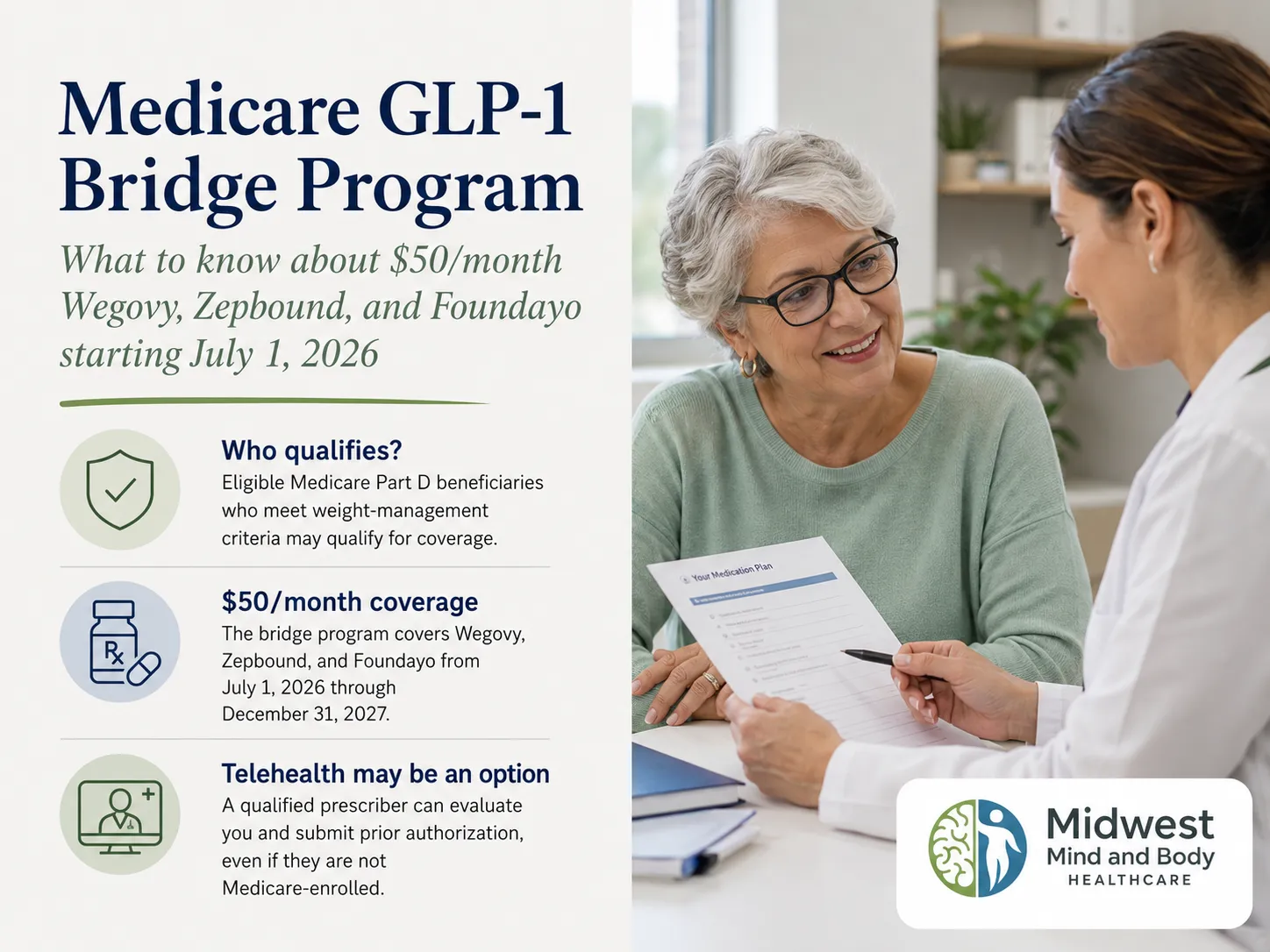
Key takeaways
- The Medicare GLP-1 Bridge Program is live. It took effect July 1, 2026 and runs through December 31, 2027.
- Eligible Medicare Part D beneficiaries pay a $50 per month medication copay for Wegovy, Zepbound, or Foundayo through the bridge.
- Three FDA-approved medications are covered: Wegovy (semaglutide), Zepbound (tirzepatide), and Foundayo (orforglipron, the first oral GLP-1 pill for weight loss).
- Providers do not need to be enrolled in Medicare to write a prescription under the bridge program. This means you can use a telehealth provider or a clinician who only offers cash-pay visits.
- Provider visits are separate from and in addition to the medication copay, and are billed through Medicare. Your share of visit costs depends on your specific Medicare coverage.
- Prior authorization through your Part D plan is typically required to access the bridge benefit.
What is the Medicare GLP-1 Bridge Program?
The Medicare GLP-1 Bridge is a CMS (Centers for Medicare and Medicaid Services) demonstration program announced in early 2026. Until now, traditional Medicare did not cover GLP-1 medications when prescribed for weight loss. Patients on Medicare who wanted Wegovy or Zepbound for chronic weight management typically paid full cash price, often $1,000 to $1,500 per month, putting these medications out of reach for most fixed-income beneficiaries.
The bridge program changes that. As of July 1, 2026, eligible Medicare Part D beneficiaries can access three FDA-approved GLP-1 medications for chronic weight management at a flat $50 per month medication copay. CMS is calling this a "bridge" because it is an 18-month demonstration intended to gather data on cost, utilization, and clinical outcomes. That data will inform whether Medicare permanently adds GLP-1 weight management coverage in the future.
Which medications are covered?
Three FDA-approved GLP-1 medications are eligible under the bridge program when used to reduce excess body weight and maintain weight reduction:
- Wegovy (semaglutide), available as a weekly injection or daily oral tablet, manufactured by Novo Nordisk
- Zepbound (tirzepatide), available in the KwikPen autoinjector format, manufactured by Eli Lilly
- Foundayo (orforglipron), the first non-peptide, small-molecule oral GLP-1 for weight loss, recently FDA-approved and manufactured by Eli Lilly
Each of these medications works by mimicking the activity of glucagon-like peptide-1, a hormone that regulates appetite, fullness, and blood sugar. Read our deeper guide on medical weight loss with GLP-1 medications for clinical details on how these medications work and how they compare.
Medications NOT covered under the bridge include Ozempic, Mounjaro, Saxenda, Victoza, and other GLP-1 medications when prescribed for diabetes only. The bridge specifically targets the chronic weight management indication.
Wegovy vs Zepbound vs Foundayo: how they compare
| Feature | Wegovy | Zepbound | Foundayo |
|---|---|---|---|
| Generic name | Semaglutide | Tirzepatide | Orforglipron |
| Manufacturer | Novo Nordisk | Eli Lilly | Eli Lilly |
| Form | Weekly injection or daily oral tablet | Weekly injection (KwikPen) | Daily oral pill (non-peptide) |
| Mechanism | GLP-1 receptor agonist | Dual GLP-1/GIP agonist | GLP-1 receptor agonist (small molecule) |
| Average weight loss (clinical trials) | ~15-17% of body weight | ~21% of body weight (highest dose) | ~12.4% of body weight (highest dose) |
| Food/water timing | None for injection; tablets must be taken on an empty stomach with ≤4 oz water, then wait 30 minutes before eating | None (injection) | None, take any time of day with or without food |
| Bridge program cost | $50/month | $50/month | $50/month |
Foundayo's main advantage is convenience: it's a non-peptide oral GLP-1 pill with no food or water timing restrictions, unlike the Wegovy tablet which requires fasted dosing. Wegovy injection has the longest track record, including FDA approval for cardiovascular risk reduction in some patients. Zepbound has shown the highest average weight loss in clinical trials. The right medication depends on individual goals, tolerability, and clinical factors.
Who is eligible?
To use the Medicare GLP-1 Bridge benefit, patients generally need to meet all of the following:
- Be enrolled in Medicare Part D (a standalone prescription drug plan or Medicare Advantage plan with prescription drug coverage)
- Be at least 18 years old AND meet one of three BMI-based eligibility tiers (more restrictive than the general FDA label):
- Tier 1: BMI of 35 or higher (no additional conditions required), or
- Tier 2: BMI of 30 or higher WITH heart failure with preserved ejection fraction, OR uncontrolled hypertension (systolic blood pressure above 140 mm Hg or diastolic above 90 mm Hg despite treatment with two antihypertensive medications), OR chronic kidney disease stage 3a or above, or
- Tier 3: BMI of 27 or higher WITH prediabetes (per American Diabetes Association guidelines), previous myocardial infarction, previous stroke, or symptomatic peripheral artery disease
- Be using the medication in combination with current and ongoing lifestyle modification including structured nutrition and physical activity
- Have a prescription from a qualified prescriber (any licensed clinician with prescribing authority can prescribe; the provider does not need to be Medicare-enrolled)
- Receive prior authorization from your Part D plan, which is the standard pre-approval process Medicare uses for covered medications
Patients who initiated GLP-1 therapy before the Bridge Program launched can still qualify if they met the BMI criteria at the time therapy was initiated, even if their current BMI is now lower (a common situation for patients who have already achieved meaningful weight loss).
Eligibility verification happens through your Part D plan, not through CMS directly. If you are unsure whether you qualify, your provider or pharmacist can help submit a prior authorization request to confirm coverage.
How much will I actually pay each month?
There are two costs to think about: the medication itself and the clinical visit.
1. Medication cost: $50 per month
Through the bridge program, your Part D plan caps the medication copay at $50 per month for Wegovy, Zepbound, or Foundayo. You pay this directly to the pharmacy when you fill the prescription.
2. Provider visit cost: in addition, billed through Medicare
You need a prescription, which means you need a clinical visit. Provider visits for evaluation, prescribing, and follow-up are in addition to the $50 medication copay and are billed through Medicare. Your share of visit costs depends on your specific Medicare coverage, including your deductible, coinsurance, and any supplemental (Medigap) or Medicare Advantage plan, so it varies by patient. The medication itself is the same $50 monthly copay through the Bridge regardless of where you receive your clinical care.
Total monthly cost: scenario comparison
| Scenario | Medication cost | Provider visits (in addition) | Total per month |
|---|---|---|---|
| Medicare GLP-1 Bridge | $50 | Billed through Medicare; your share varies by coverage | $50 + your visit share |
| Without Bridge (retail cash pay) | $1,000-1,500 | $60-200 | $1,060-1,700 |
| Without Bridge (commercial insurance) | Often denied for weight loss | Standard copay | Highly variable |
The Bridge Program reduces monthly medication cost by roughly $1,000 compared to retail cash pay. For Medicare beneficiaries who previously could not afford GLP-1 medications for weight loss, this is the first realistic path to coverage.
How does the program actually work, step by step?
The patient experience is similar to filling any other prescription, with one extra step for the prior authorization:
- Schedule a clinical visit with a qualified prescriber. This can be in-person or via telehealth. The provider does not need to be Medicare-enrolled, but they must not be on the CMS Preclusion List (a list of providers Medicare has excluded; almost no one is on it).
- Discuss eligibility and medication choice with your clinician. They will assess BMI, weight-related conditions, medical history, and contraindications, then recommend which GLP-1 is best for your situation (Wegovy, Zepbound, or Foundayo).
- Provider submits the prescription and prior authorization to your Part D plan. This typically takes a few business days; some Part D plans may approve same-day, others may require additional documentation.
- Once approved, fill at your pharmacy. You pay the $50 copay; Medicare Part D covers the rest under the bridge benefit.
- Continue follow-up visits as recommended by your clinician, typically monthly during titration and every 1-3 months once stable.
Do I need a Medicare-enrolled doctor?
No. This is one of the most important details of the bridge program, and one of the most misunderstood. Per CMS:
"A provider does not need to be enrolled in Medicare in order to write a prescription or submit a prior authorization request for products provided under the Medicare GLP-1 Bridge to an eligible beneficiary."
What this means in practice: you can use any qualified prescriber, including telehealth providers, cash-only practices, and clinicians who do not accept Medicare for office visits. As long as the provider is licensed to prescribe and is not on the CMS Preclusion List, they can write your bridge prescription.
This is significant because it opens up access to providers who specialize in GLP-1 prescribing but do not bill Medicare directly. For Medicare patients in areas where local Medicare-enrolled providers have long wait times or are not accepting new patients, telehealth options become a viable path.
What about Ozempic and Mounjaro?
Ozempic (semaglutide for type 2 diabetes) and Mounjaro (tirzepatide for type 2 diabetes) are the same active ingredients as Wegovy and Zepbound, but they are FDA-approved for diabetes, not weight management. The Medicare GLP-1 Bridge specifically covers the weight management indications, so Ozempic and Mounjaro are not part of the bridge program.
If you have type 2 diabetes and are prescribed Ozempic or Mounjaro for blood sugar management, your Part D plan may already cover those medications through standard diabetes coverage. The bridge program is specifically for patients seeking chronic weight management, not diabetes treatment.
What if I'm interested but I don't have Medicare yet?
The bridge program is exclusively for Medicare Part D beneficiaries. If you are under 65 and not on Medicare, the bridge does not apply to you. Cash-pay or commercial insurance options remain the path for most working-age adults seeking GLP-1 medications.
For commercial insurance patients, see our guide on what to do when insurance denies your Wegovy or Zepbound prescription, which covers documentation strategies, appeals, and cash-pay alternatives.
Will Medicare permanently cover GLP-1s after the bridge ends?
That decision has not been made. The bridge program is an 18-month demonstration intended to give CMS data on whether expanded GLP-1 coverage for chronic weight management makes sense long-term. Factors CMS will look at include actual prescription utilization, medication costs, patient outcomes, and broader Medicare budget impact.
Patients should plan for the program to end on December 31, 2027, unless extended. Anyone using the bridge benefit should also discuss long-term planning with their clinician, including what happens if coverage does not extend beyond the demonstration period.
Common side effects and safety considerations
All three medications can cause nausea, vomiting, diarrhea, and constipation, especially during dose titration. These are usually mild to moderate and improve over time as the body adjusts to the medication.
More serious considerations include risk of pancreatitis, gallbladder problems, kidney injury (often related to dehydration from gastrointestinal symptoms), and rare cases of medullary thyroid cancer (these medications carry a black box warning for patients with personal or family history of MTC or MEN2 syndrome).
Patients who should not use these medications include those with a personal or family history of medullary thyroid carcinoma, MEN2 syndrome, severe gastroparesis, or active eating disorders. Pregnancy and planned pregnancy are also contraindications, and patients should stop these medications well before any planned pregnancy.
Working with a clinician who monitors response, side effects, and safety markers, and who adjusts the dose or medication as needed, is part of safe GLP-1 prescribing. The clinical visit is not just for writing the prescription. It's where ongoing risk and benefit get weighed for your specific situation.
Frequently asked questions
What is the Medicare GLP-1 Bridge Program?
The Medicare GLP-1 Bridge is a CMS demonstration program that provides eligible Medicare Part D beneficiaries with access to certain GLP-1 weight management medications for $50 per month. The program runs from July 1, 2026 through December 31, 2027.
Which medications does the Medicare GLP-1 Bridge cover?
The bridge program covers three FDA-approved GLP-1 medications when used for chronic weight management: Wegovy (semaglutide injection and tablets), Zepbound (tirzepatide KwikPen), and Foundayo (orforglipron, the first oral GLP-1 pill for weight loss).
Who qualifies for the Medicare GLP-1 Bridge?
Medicare Part D beneficiaries 18 or older who meet one of three BMI tiers: (1) BMI of 35 or higher with no additional conditions required; (2) BMI of 30 or higher with heart failure with preserved ejection fraction, uncontrolled hypertension despite two antihypertensive medications, or chronic kidney disease stage 3a or above; or (3) BMI of 27 or higher with prediabetes, previous heart attack, previous stroke, or symptomatic peripheral artery disease. Patients must also be using the medication alongside structured nutrition and physical activity. Prior authorization through your Part D plan is required.
How much will I actually pay each month?
Your cost has two parts. The medication copay is $50 per month, paid to your pharmacy. Provider visits are in addition to the medication copay and are billed through Medicare; your share depends on your specific Medicare coverage, including deductibles, coinsurance, and any supplemental or Medicare Advantage plan, so it varies by patient.
Do I need a Medicare-enrolled doctor to use the Bridge Program?
No. Per CMS, providers do not need to be enrolled in Medicare to write a prescription or submit a prior authorization request for medications under the Medicare GLP-1 Bridge. The provider simply must not be on the CMS Preclusion List. This gives Medicare patients more flexibility in choosing a clinician, including telehealth providers and clinics that operate outside the traditional Medicare network.
When does the Medicare GLP-1 Bridge start and end?
The program took effect July 1, 2026 and runs through December 31, 2027. CMS may extend, modify, or make the coverage permanent based on results, but as currently structured the bridge is an 18-month demonstration program.
Will Medicare permanently cover GLP-1s for weight loss after the bridge ends?
That decision has not been made. The bridge program is a demonstration intended to generate data on cost, utilization, and outcomes. CMS will use that data to inform whether to make GLP-1 weight management coverage permanent under Medicare. Patients should plan for the program to end on December 31, 2027 unless extended.
Evidence & References
- Medicare GLP-1 Bridge. Centers for Medicare & Medicaid Services. 2026.
- Coming Soon: CMS to Provide $50 Monthly Access to GLP-1 Medications for Medicare Beneficiaries. CMS Press Release. 2026.
- FDA approves Lilly's Foundayo (orforglipron), the only GLP-1 pill for weight loss that can be taken any time of day without food or water restrictions. Eli Lilly and Company. 2025.
The Bridge is live. Ready to see if you qualify?
The Medicare GLP-1 Bridge took effect July 1, 2026, and we are scheduling Medicare eligibility visits now. Book a visit and we will confirm your tier, gather the documentation, and submit your prior authorization.
For complete program details and pricing scenarios, see our Medicare GLP-1 Bridge service page.
This content is for educational purposes only and does not replace medical advice. Eligibility for the Medicare GLP-1 Bridge Program depends on individual Part D plan coverage and clinical criteria. Treatment decisions are individualized and discussed during your visit. Information accurate as of July 2026; program terms may be updated by CMS.