The short answer
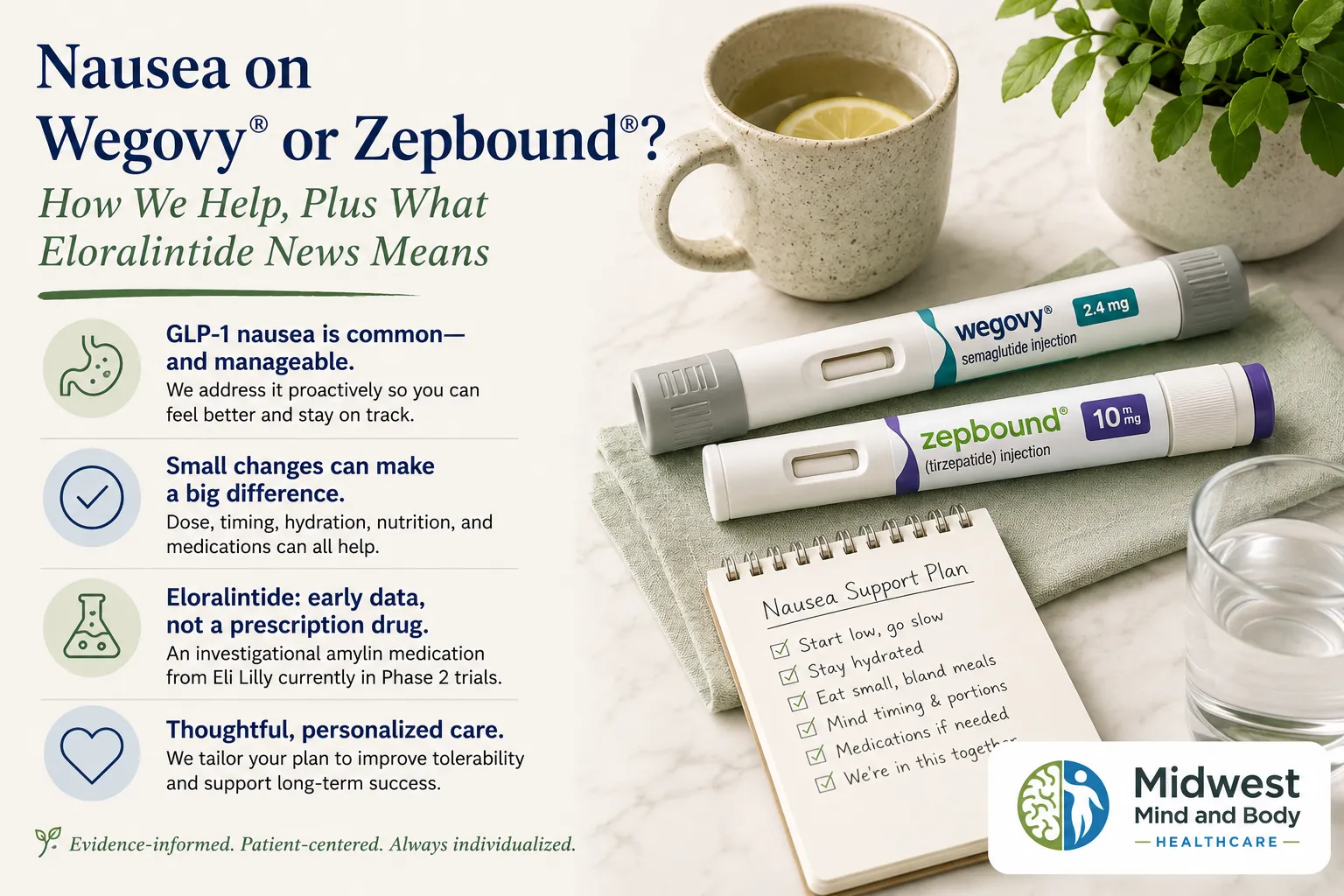
Nausea is one of the most common side effects we see with Wegovy, Zepbound, and other GLP-1 medications, and it is one of the most common reasons patients consider stopping. In our clinic, we treat GLP-1 nausea as a problem to address actively, not as an inevitable cost of the medication. Most patients are able to continue treatment with the right adjustments.
You may have read about eloralintide, an investigational medication Eli Lilly is developing that targets the amylin pathway instead of GLP-1 and showed strong weight loss in a Phase 2 trial reported in The Lancet. Eloralintide is not FDA-approved and will not be available for years. For someone struggling with GLP-1 side effects today, the most useful next step is usually to adjust the current plan, not to wait for a medication that does not yet exist.
Key takeaways
- Nausea is the most common side effect of Wegovy, Zepbound, Ozempic, Mounjaro, and Foundayo, and the most common reason patients in trials and in clinic consider stopping.
- In our clinic, GLP-1 nausea is something we address the same week it comes up, not at the next visit. Most patients are able to continue treatment.
- Eloralintide (Eli Lilly, development code LY3841136) is an investigational, selective amylin receptor agonist. A 48-week Phase 2 trial reported in The Lancet in 2025 showed mean weight reduction ranging from approximately 9% at the lowest dose to 20% at the highest dose, compared with 0.4% on placebo.
- Phase 2 results suggested lower nausea and gastrointestinal side effects than has been reported in injectable GLP-1 trials, with more reports of fatigue. These findings have not yet been confirmed in Phase 3.
- Eloralintide is not FDA-approved and is not available for prescription. We are not prescribing it. A realistic earliest FDA decision is 2028, assuming Phase 3 confirms the Phase 2 findings.
- If you are struggling with side effects on a GLP-1 medication today, please contact us before stopping. We respond the same week.
How common is nausea on Wegovy, Zepbound, and other GLP-1 medications?
Nausea is the single most common side effect of GLP-1 receptor agonist medications and the most common reason patients in clinical trials and in clinic discontinue treatment. In the Phase 3 trials, nausea was reported by approximately 44% of patients on Wegovy (semaglutide 2.4 mg) and approximately 28% of patients on Zepbound (tirzepatide 15 mg) during dose titration, usually mild to moderate, and usually improving with time and dose stabilization. Vomiting, diarrhea, constipation, and reflux symptoms are also reported.
In our experience, the rate at which patients are willing and able to stay on treatment depends less on the medication itself than on how their clinical team responds to symptoms.
What we do in clinic when nausea is the problem
Nausea is one of the most common conversations we have during the first three months of GLP-1 treatment. We treat it as a clinical problem to solve, not an inevitable cost of the medication. A few patterns in how we approach it:
We listen first. Before adjusting anything, we ask what the nausea actually feels like, when it happens during the day, how it relates to meals, and how it is affecting eating, hydration, sleep, and work. Generic advice rarely helps. Specific changes do.
We adjust the titration schedule rather than push through. The FDA-approved Wegovy and Zepbound titration schedules are starting points, not requirements. If you are nauseated at the 0.5 mg or 5 mg step, we are comfortable holding you there for an extra month or two before advancing. Weight loss may be slower for a few weeks, and that is acceptable.
We use supportive medications when appropriate. A short course of anti-nausea medication can carry someone through a hard week of titration. We discuss the options, the limits, and what they are for.
We talk about how you are eating, not just what. Smaller meals, eating slowly, stopping when comfortably full rather than waiting for full, less greasy or spicy food during titration, fluids spaced out from meals. These changes sound simple. Most patients have not been told them.
We screen for other causes. Severe or persistent nausea is not always the medication. We look for medication interactions, gallbladder symptoms, gastroparesis red flags, pregnancy when relevant, and other conditions that may need separate evaluation.
We are reachable. If side effects flare between visits, you do not have to wait for your next appointment. Portal messaging is the fastest way, and we respond the same week. We would rather adjust a plan in time to help than read about a problem at a visit a month later.
We are willing to consider a different medication. If we have done the work and nausea is still limiting treatment, switching between Wegovy and Zepbound, or to Foundayo (the oral GLP-1), is a real option. These medications share enough mechanism to be in the same class, but not enough that every patient experiences side effects the same way on each one.
Kim Wohlwend, MSN, APRN
What is eloralintide?
Eloralintide (development code LY3841136) is an investigational medication Eli Lilly is developing for chronic weight management. It is a once-weekly injection. Unlike Wegovy, Zepbound, Ozempic, Mounjaro, and Foundayo, eloralintide does not act on the GLP-1, GIP, or glucagon receptors. It is a selective amylin receptor agonist, meaning it works through a different appetite-regulating hormone pathway.
Amylin is a hormone released by the pancreas alongside insulin after a meal. It contributes to the sense of fullness, slows the rate at which the stomach empties, and influences appetite signals in the brain. An older amylin-based medication (pramlintide) has been used alongside insulin in some patients with diabetes for years. Eloralintide is a longer-acting, more selective drug being developed specifically for weight management.
What did the Phase 2 trial show?
The Phase 2 trial of eloralintide was reported in The Lancet. It followed adults with obesity or overweight (without type 2 diabetes) over 48 weeks. The reported findings:
- Mean body weight reduction ranged from approximately 9% at the lowest dose to 20% at the highest dose, compared with 0.4% on placebo.
- The high-dose arm at 9 mg produced the 20% reduction.
- All eloralintide arms met the primary endpoint of superior weight reduction versus placebo.
- The medication was described as generally well tolerated.
This is in the general range of the figures reported for injectable Wegovy and Zepbound in their own trials, but direct head-to-head comparisons have not been done.
The important caveat: this was a Phase 2 trial. Phase 2 results often do not hold up unchanged in Phase 3, where the patient population is broader, the follow-up is longer, and more side-effect signals tend to emerge. Phase 3 enrollment has not yet begun.
How is the side-effect profile different?
In the Phase 2 data, nausea rates varied substantially by dose. Nausea ranged from approximately 11% at the lowest 1 mg dose to 64% in some intermediate-dose arms, with about 33% reported in the 9 mg fixed-dose arm (the highest-efficacy arm). For comparison, nausea has been reported at approximately 44% in the Wegovy semaglutide trials and 28% in the Zepbound tirzepatide trials. The high-efficacy 9 mg eloralintide arm therefore showed less nausea than the typical semaglutide rate but slightly more than the typical tirzepatide rate; lower-dose eloralintide arms showed substantially less nausea than either GLP-1 medication. Fatigue followed a similar dose-dependent pattern, ranging from near 0% at the lowest dose to about 46% in some higher-dose arms, compared with about 13% in the semaglutide arm of STEP 3.
It is reasonable to take both observations seriously as hypotheses, with two cautions:
- Phase 2 trials are smaller, and the trial populations are not identical to GLP-1 trial populations. Cross-trial comparisons have real limits.
- The longer-term safety and tolerability profile is not yet known.
If the lower-nausea signal holds up in Phase 3, eloralintide may eventually become a meaningful option for patients who cannot tolerate GLP-1 medications. That is not the situation today.
Is eloralintide available now?
No. Eloralintide is investigational and is not FDA-approved. We are not prescribing it. We will not prescribe it unless and until it receives FDA approval for weight management. Eli Lilly has announced plans to begin Phase 3 enrollment by the end of 2026. A realistic earliest FDA decision window, assuming Phase 3 confirms the Phase 2 findings, is 2028.
If you see eloralintide offered for sale online by a compounding pharmacy, a peptide vendor, or a direct-to-consumer telehealth service, that product is not the FDA-approved medication, because there is not yet an FDA-approved medication to compound or copy. We do not recommend obtaining investigational medications through these channels. Compounded and gray-market weight-loss products have been the subject of FDA enforcement and patient safety reports.
What does the eloralintide news mean for patients on Wegovy or Zepbound today?
For patients already on a GLP-1 medication, the eloralintide news does not change today's plan. If treatment is working, the right step is to continue with appropriate monitoring. If side effects are the issue, the right step is to talk with us before discontinuing. Waiting two or more years for an unapproved drug class is rarely the best option for someone who is losing weight and has medical reasons to stay on treatment.
For patients who have not yet started treatment and are considering options, eloralintide does not change today's decision either. The medications available now have substantial trial evidence, established safety profiles, and known cost paths. We will revisit treatment options if and when eloralintide is approved and the longer-term data are in.
What we tell patients
If you are struggling with nausea, fatigue, or other side effects on a GLP-1 medication, please contact us before stopping treatment. We address GLP-1 side effects the same week they come up. Whether the right answer turns out to be a dose pause, a slower titration, supportive medication, a switch between Wegovy and Zepbound, or a different approach, we want to be in the conversation when that decision is made.
If you have been waiting to start weight management treatment because you are hoping for something with fewer side effects, eloralintide is not yet that option. We are happy to talk through what is approved and available now.
The bottom line
Eloralintide is interesting Phase 2 news, but it is not a treatment that is available to patients today. The most useful response to GLP-1 side effects right now is not to wait for a new drug class. It is to work with a clinical team that takes side effects seriously and responds quickly.
If you are dealing with nausea, fatigue, or other side effects on a GLP-1 medication, please contact us. Most of the time, we can help you stay on treatment.
Frequently asked questions
Is eloralintide approved by the FDA?
No. Eloralintide is an investigational medication. It is not FDA-approved for any use and is not available for prescription. Eli Lilly has announced plans to begin Phase 3 trials by the end of 2026. A realistic earliest FDA decision window, assuming Phase 3 confirms the Phase 2 findings, is 2028.
Can I get eloralintide compounded?
No legitimate compounded version of eloralintide is currently available, and we do not recommend obtaining investigational medications from compounding pharmacies, online clinics, or peptide vendors. Products sold this way are not the FDA-approved medication and have not been through the safety and quality controls that apply to approved drugs.
Is eloralintide a GLP-1 medication?
No. Eloralintide is a selective amylin receptor agonist. It acts on a different appetite-regulating hormone pathway from Wegovy, Zepbound, Ozempic, Mounjaro, and Foundayo, which all involve GLP-1.
Did the Phase 2 trial show fewer side effects than Wegovy or Zepbound?
Side-effect rates in the Phase 2 trial varied substantially by dose. Nausea ranged from approximately 11% at the lowest 1 mg dose to 64% in some intermediate-dose arms, with about 33% in the 9 mg fixed-dose (highest-efficacy) arm. For comparison, the Wegovy trials reported nausea at approximately 44% and the Zepbound trials at approximately 28%. The 9 mg eloralintide arm therefore showed less nausea than semaglutide but slightly more than tirzepatide; lower-dose arms showed less than either. Fatigue followed a similar dose-dependent pattern, ranging from near 0% at the lowest dose to about 46% in some higher-dose arms, compared with about 13% in the semaglutide arm of STEP 3. Direct head-to-head comparisons have not been done. Phase 3 trials will provide a clearer side-effect picture.
Should I stop my GLP-1 medication to wait for eloralintide?
Generally no. Stopping a working treatment to wait for an investigational medication that is at least two years away from possible approval is not a decision we typically recommend. If side effects on your current medication are the issue, please contact us. We address GLP-1 side effects actively rather than as an inevitable cost of treatment.
Are you prescribing eloralintide now?
No. We are not prescribing eloralintide. We will not prescribe it unless and until it receives FDA approval for weight management. If and when it becomes available and the data supports it, we will discuss it during visits.
How common is nausea on Wegovy and Zepbound?
Nausea is the most common side effect of GLP-1 receptor agonist medications. In the Phase 3 trials, nausea was reported by approximately 44% of patients on Wegovy (semaglutide 2.4 mg) and approximately 28% of patients on Zepbound (tirzepatide 15 mg) during dose titration, usually mild to moderate and usually improving with time and dose stabilization. In our clinic, we address nausea as a clinical problem the same week it comes up, and most patients are able to continue treatment with appropriate adjustments.
Evidence & References
- Billings LK, et al. Eloralintide, a selective amylin receptor agonist for the treatment of obesity: a 48-week phase 2, multicentre, double-blind, randomised, placebo-controlled trial. The Lancet. 2025;406(10520):2631-2643.
- Lilly's selective amylin agonist, eloralintide, demonstrated meaningful weight loss and favorable tolerability in a Phase 2 study of adults with obesity or overweight. Eli Lilly and Company press release, 2026.
- Eli Lilly's Phase II Trial of Eloralintide Shows Up to 20% Weight Reduction in Adults With Obesity. Applied Clinical Trials Online, 2026.
- New GLP-1 alternative, eloralintide, leads to 20% weight loss in trial. Medical News Today, 2026.
- Can amylin weight-loss drugs compete in a world of GLP-1s? Chemical & Engineering News, 2026.
- A Study of Eloralintide (LY3841136) in Participants With Obesity, or Overweight Without Type 2 Diabetes (NCT07321886). ClinicalTrials.gov.
Struggling with nausea on Wegovy, Zepbound, or another GLP-1?
Please reach out before stopping. We address GLP-1 side effects the same week they come up, with dose adjustments, slower titration, supportive care, and close follow-up. Medical weight loss at Midwest Mind and Body Healthcare is $60 initial visit, then $60 per month for ongoing care. Telehealth in 16 states.
Book an AppointmentThis content is for educational purposes only and does not replace medical advice. Treatment decisions are individualized and discussed during your visit. Investigational medications are not available for prescription and should not be obtained through compounding pharmacies, peptide vendors, or direct-to-consumer services outside FDA-approved channels.