The short answer
Not for cancer prevention on its own. GLP-1 medications like Wegovy, Zepbound, and Foundayo are not FDA-approved as cancer prevention drugs, and they should not be started in someone at a healthy weight just to lower cancer risk.
But if you are already considering a GLP-1 for weight or for type 2 diabetes, new data presented at the American Society of Clinical Oncology Annual Meeting on May 29, 2026 adds something real to that conversation, especially for women in midlife with a family history of breast or other obesity-related cancers.
Here is what changed this week, what it means, what it does not mean, and what we tell patients in clinic when they ask.
Key takeaways
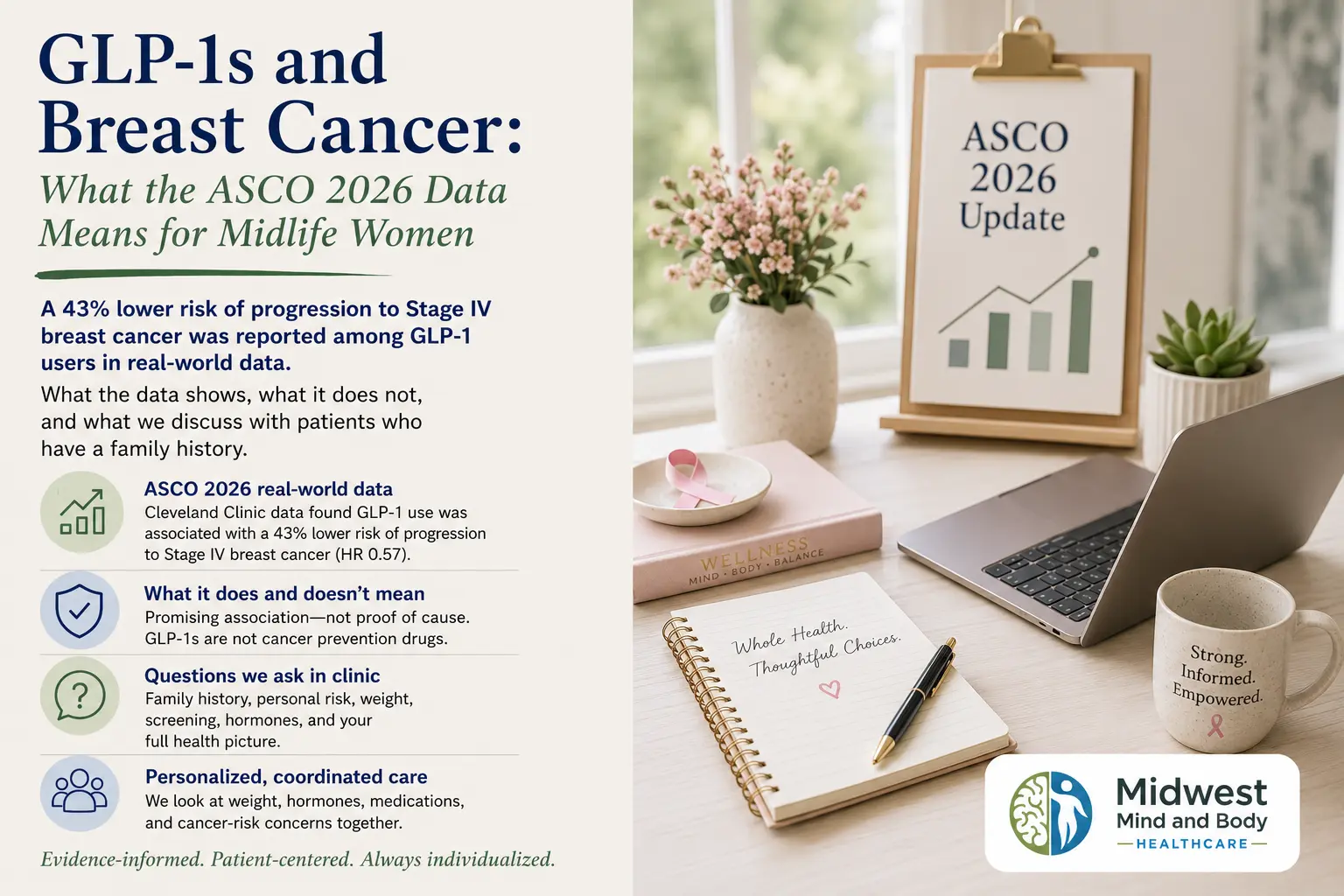
- Cleveland Clinic real-world data presented at ASCO 2026 found patients who started a GLP-1 receptor agonist (semaglutide or tirzepatide) after a breast cancer diagnosis were about 43% less likely to progress to Stage IV disease than patients who started a DPP-4 inhibitor (hazard ratio 0.57, 95% CI 0.46 to 0.71; abstr 3143).
- Similar reductions in progression to Stage IV appeared in non-small cell lung cancer (10% vs 22%), colorectal cancer, and liver cancer.
- A separate JAMA Oncology study by Dai and colleagues (2025) found about 17% lower overall cancer incidence (hazard ratio approximately 0.83) in adults with obesity who used GLP-1 receptor agonists.
- This is observational data and cannot prove cause and effect. GLP-1 medications are not approved as cancer prevention or cancer treatment.
- Family history of breast cancer is not a contraindication to GLP-1 medications. Personal or family history of medullary thyroid carcinoma (MTC) or MEN 2 is.
- For someone already considering a GLP-1 for weight or diabetes, this data adds a factor on the benefit side. It does not turn a non-candidate into a candidate.
What did the ASCO 2026 data actually show?
The American Society of Clinical Oncology Annual Meeting opened in Chicago on May 29, 2026. Cleveland Clinic researchers presented a propensity-matched analysis of 10,225 patients who initiated GLP-1 receptor agonist therapy (semaglutide or tirzepatide; tirzepatide is technically a dual GIP and GLP-1 receptor agonist) after a Stage I to III obesity-related cancer diagnosis, comparing them with patients who started a DPP-4 inhibitor instead. The analysis produced approximately 6,056 matched pairs across seven cancer types (J Clin Oncol 44, 2026 suppl 16, abstr 3143).
The headline finding was in breast cancer. Patients who started a GLP-1 were approximately 43% less likely to progress to Stage IV disease than patients who started a DPP-4 inhibitor, with a hazard ratio of 0.57 (95% confidence interval 0.46 to 0.71).
Similar patterns appeared in other obesity-related cancers:
- Non-small cell lung cancer: progression to Stage IV roughly 10% versus 22%
- Colorectal cancer: statistically significant reduction in progression
- Hepatocellular (liver) cancer: signal in the same direction
A separate JAMA Oncology study by Dai and colleagues (2025), distinct from the Cleveland Clinic ASCO analysis, found about a 17% lower overall cancer incidence (hazard ratio approximately 0.83) in adults with obesity who used GLP-1 receptor agonists, with most of the signal coming from skin cancers and obesity-related solid tumors.
The proposed mechanisms include weight loss itself, improved insulin signaling, lower systemic inflammation, and possibly direct effects on GLP-1 receptors expressed by some cancer cells. None of those mechanisms is confirmed.
What did the study not prove?
This was an observational study. Patients started a GLP-1 or a DPP-4 inhibitor for reasons the data cannot fully control for. The two groups may have differed in baseline risk, screening frequency, treatment adherence, or general health behaviors in ways that affect cancer outcomes.
Observational data can show an association. It cannot prove cause and effect. A 43% reduction in metastatic progression is striking enough to justify dedicated randomized trials, and those will take years.
What this data does not mean:
- GLP-1 medications are not FDA-approved for cancer prevention.
- Wegovy, Zepbound, and Foundayo are not cancer treatments and should not be used as one.
- Someone at a healthy weight should not start a GLP-1 just to lower cancer risk. The risk-benefit math does not support that.
Should I start a GLP-1 just for cancer protection?
No. Not yet, and probably not for some time.
For someone who is already a candidate for medical weight loss or diabetes management, this data modestly strengthens the benefit side of an existing decision. For someone at a healthy weight without diabetes, GLP-1 medications come with real costs: gastrointestinal side effects, monthly expense, the time and attention of follow-up, and the small risks that come with any medication. Trading those for a possible cancer benefit that has not yet been shown in a randomized trial is not a calculation we are comfortable recommending.
What about the thyroid and pancreatic cancer worry?
This is the question most patients actually open with. Not "will it prevent cancer," but "will it cause cancer."
The short answer is reassuring, with one specific exception.
The boxed warning on Wegovy, Ozempic, Zepbound, and Mounjaro is for medullary thyroid carcinoma (MTC) and Multiple Endocrine Neoplasia syndrome type 2 (MEN 2). The signal came from rodent studies. Large randomized trial meta-analyses in humans (including Ko and colleagues, Annals of Internal Medicine, 2025) have not confirmed a statistically significant increase in MTC. Pharmacovigilance reports do show signals that have not been fully explained, and the question is not entirely settled. The contraindication is clear regardless: a personal or family history of MTC or MEN 2 is a hard no.
For common thyroid conditions like hypothyroidism or Hashimoto's, GLP-1 medications are not contraindicated. Thyroid status should still be optimized and monitored.
For pancreatic cancer, large 2025 to 2026 reviews including an Annals meta-analysis found little or no increase in risk. The early observational signals have not held up under closer review.
What we see in clinic
The conversation patients bring to us has shifted noticeably over the last few weeks. Where the GLP-1 question used to be "will this work" or "can I afford it," more women in their mid-forties through sixties are now asking some version of "my mother (sister, aunt) had breast cancer. Does that change anything?"
A few patterns we see often:
The patient who heard about the Cleveland Clinic finding from a friend and wants to know if she should start. We ask first about her BMI, her cardiometabolic risk, her current screening schedule, and what her primary care or gynecology clinician has recommended. The data does not turn a non-candidate into a candidate. It does add a factor when she is already on the fence.
The patient at BMI 27 to 30 with a strong family history. This is the gray zone. FDA labels approve GLP-1 weight management at BMI 30 alone or BMI 27 with a weight-related condition. A first-degree relative with breast cancer is not, by itself, a weight-related condition. But these conversations now include more nuance than they did a year ago, especially when perimenopause, sleep apnea, or prediabetes are also in the picture.
The patient who has had a benign breast biopsy and is worried. The cancer progression data does not apply directly to her situation, because she does not have cancer. We slow the conversation down, go through what was actually found, and coordinate with her breast care provider when the question goes beyond what we can answer in a weight management visit.
The breast cancer survivor on tamoxifen or an aromatase inhibitor asking about Wegovy for weight gain. These are decisions we make alongside her oncologist, not instead of her oncologist. GI side effects of GLP-1 medications can overlap with side effects of endocrine therapy in ways that matter, and the right answer depends on her specific treatment plan.
The patient who heard "Wegovy prevents cancer" on a podcast and now wants to start regardless of weight. This is the conversation where we slow down and explain what observational data shows and what it does not. Most patients appreciate having the question taken seriously instead of dismissed.
What we check before starting a GLP-1, regardless of cancer history:
- Personal and family history of medullary thyroid cancer or MEN 2
- Personal history of pancreatitis or significant gallbladder disease
- Current eating disorder symptoms
- Other medications that may interact
- Pregnancy plans, since these medications are not for use during pregnancy
- Whether age- and risk-appropriate cancer screening (mammogram, colonoscopy, cervical) is up to date
Three things we try not to assume:
- That a strong family history of breast cancer changes someone's GLP-1 candidacy by itself.
- That the absence of obesity rules a patient out of any cancer-risk conversation.
- That a patient who has done her own reading wants to be told what to think.
Kim Wohlwend, MSN, APRN
Who is this data most relevant for?
This research is most useful for adults already weighing GLP-1 medications for weight management or type 2 diabetes. For them, the new findings modestly strengthen the case for treatment, especially in someone with a family history of an obesity-related cancer.
It is less directly useful for:
- Adults at a healthy weight without diabetes, considering GLP-1 as primary cancer prevention. The data does not support that use.
- Adults already in active cancer treatment. Those decisions are oncology decisions, made with the oncology team.
- Adults with a personal or family history of medullary thyroid cancer or MEN 2. These medications are contraindicated per the FDA boxed warning.
The bottom line
GLP-1 medications are not cancer prevention drugs. The ASCO 2026 data does not change that.
What it changes, modestly, is the conversation we have with patients in midlife who are already weighing a GLP-1 decision and have a family history of an obesity-related cancer. For them, this is one more factor on the benefit side of a decision that already had real benefits.
The question we keep coming back to is the same one we have always asked. Is a GLP-1 the right tool for this person, for these reasons, at this time.
We are watching this research closely and will update what we tell patients as randomized trial data arrives. In the meantime, if you have been on the fence about Wegovy, Zepbound, or Foundayo, and you have a family history of breast cancer that has been part of why you are thinking about it, that question deserves a careful conversation.
Frequently asked questions
Can GLP-1 medications prevent breast cancer?
No. Observational data presented at ASCO 2026 suggested an association between GLP-1 use and lower metastatic progression in obesity-related cancers, including breast cancer. Association is not causation, and GLP-1 medications are not FDA-approved for cancer prevention.
Does the breast cancer finding mean Wegovy treats cancer?
No. The study compared cancer progression in patients who started a GLP-1 after their cancer diagnosis with patients who started a DPP-4 inhibitor instead. It is not evidence that GLP-1 medications are a cancer treatment, and they should not be used as one. Cancer treatment decisions belong with an oncology team.
Are GLP-1 medications safe for someone with a family history of breast cancer?
For most patients, yes. A family history of breast cancer is not a contraindication to GLP-1 medications. These medications are contraindicated per the FDA boxed warning when there is a personal or family history of medullary thyroid carcinoma (MTC) or MEN 2. Decisions are individualized at your visit.
Should cancer survivors take a GLP-1?
That decision belongs with the patient's oncology team and weight management or primary care clinician working together. There may be valid reasons to consider or to avoid GLP-1 medications based on the specific cancer type, current treatment, and side-effect profile.
What about the boxed warning for thyroid cancer on Wegovy and Zepbound?
The boxed warning for medullary thyroid carcinoma is based on rodent studies. Large randomized trial meta-analyses in humans have not confirmed a statistically significant increase in MTC, though pharmacovigilance signals exist and the question is not fully settled. The contraindication for personal or family history of MTC or MEN 2 still applies and is a hard no. Common thyroid conditions such as hypothyroidism or Hashimoto's are not contraindications, though thyroid status should be optimized and monitored.
Should I start a GLP-1 even if I am at a healthy weight, just for cancer protection?
No. The ASCO 2026 data does not support starting a GLP-1 medication in someone at a healthy weight for cancer prevention alone. GLP-1 medications come with real costs and side effects, and the risk-benefit math does not support their use as a primary cancer prevention strategy.
Evidence & References
- GLP-1 receptor agonists may reduce metastatic progression of certain obesity-related cancers. American Society of Clinical Oncology, ASCO Annual Meeting 2026 press release.
- GLP-1 RAs may reduce metastatic progression in certain obesity-related cancers. The ASCO Post, May 2026.
- ASCO 2026: GLP-1s could reduce the risk of some obesity-related cancers progressing. Oncology Central.
- GLP-1 meds may help slow the spread of certain obesity-related cancers. U.S. News & World Report, May 27, 2026.
- Obesity drugs linked to lower cancer risk. Medscape, 2026.
- "Too good to be true?" GLP-1s and breast cancer survival. Medscape, 2026.
- Safety of semaglutide. Peer-reviewed safety review.
- Dai H, et al. GLP-1 receptor agonists and overall cancer risk in adults with obesity. JAMA Oncology, 2025 (hazard ratio approximately 0.83 for overall cancer incidence).
- Ko D, et al. Cancer risk with GLP-1 receptor agonists: meta-analysis of randomized controlled trials. Annals of Internal Medicine, 2025 (no statistically significant increase in medullary thyroid or pancreatic cancer).
Thinking about a GLP-1 and not sure if it is right for you?
Midwest Mind and Body Healthcare offers medical weight loss with brand-name GLP-1 medications, hormone-focused care, and mental health care for women in midlife. We take the family history conversation seriously and look at the full picture. Schedule a visit to talk through your goals, your history, and your options.
Book an AppointmentThis content is for educational purposes only and does not replace medical advice. Treatment decisions are individualized and discussed during your visit. Cancer screening, diagnosis, and treatment decisions belong with the appropriate oncology, breast care, and primary care providers.